Thursday, June 10, 2010

Civil War Drummer Boy Johnny Clem Takes Arms

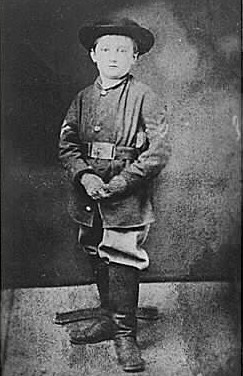
In a previous post we learned of the circumastances under which young Johnnie clem left home in order to enlist and fight for the cause. What follows here is an account of the manner in which the young Clem showed his mettle at the Battle of Chickamauga. The account is provided by Benjamin F. Taylor, military correspondent for the Chicago Evening Journal. Taylor writes:

You remember the story of little Johnny Clem, the atom of a drummer-boy, "aged ten," who strayed away from Newark, Ohio, and the first we know of him, though small enough to live in a drum, was beating the long roll for the 22d Michigan. At Chickamauga, he filled the office of a "marker," carrying the guidon whereby they form the lines, a duty having its counterpart in the surveyor's more peaceful calling in the flagman who flutters the red signal along the metes and bounds. On the Sunday of the battle, the little fellow's occupation gone, he picked up a gun that had slipped from some dying hand, provided himself with ammunition, and began putting in the periods quite on his own account, blazing away close to the ground, like a fire-fly in the grass. Late in the waning day, the waif left almost alone in the whirl of the battle, one of Longstreet's Colonels dashed up, and, looking down at him, ordered him to surrender: "Surrender!" he shouted, "you little d--d son of a -----!" The words were hardly out of the officer's mouth, when Johnny brought his piece to " order arms," and as his hand slipped down to the hammer he pressed it back, swung up the gun to the position of " charge bayonet," and as the officer raised his sabre to strike the piece aside, the glancing barrel lifted into range, and the proud Colonel tumbled dead from his horse, his lips fresh stained with the syllable of reproach he had hurled at the child.

More...

A few swift moments ticked off by musket shots, and the tiny gunner was swept up at a swoop and borne away a prisoner. Soldiers, bigger but not better, were taken with him, only to be washed back again by a surge of Federal troopers, and the prisoner of thirty minutes was again John Clem "of ours," and General Rosecrans made him a Sergeant, and the stripes of rank covered him all over like a mouse in a harness, and the daughter of Mr. Secretary Chase presented him a silver medal appropriately inscribed, which he worthily wears, a royal order of honor, upon his left breast, and all men conspire to spoil him, but, since few ladies can get at him here, perhaps he may be saved. Think of a sixty-three pound Sergeant, fancy a handful of a hero, and then read the "Arabian Nights" and believe them.

Wednesday, March 3, 2010

A drummer boy recounts the Battle of Chickamauga

In "A Drummer Boy's Diary: Comprising Four Years of Service with the Second Regiment Minnesota Veteran Volunteers, 1861-1865, drummer boy William Bircher recounts his observations and experiences at the commencement of the Battle of Chickamauga. Bircher writes:

September 19th: Hot and dusty. At daybreak, as we marched along, we saw troops falling into line on the right of the road; the artillery was unlimbered, the gunners stood to their guns, and every thing had the appearance of a battle. We marched along the rear of the line until we reached the left wing of the army, where we piled up our knapsacks, formed in line, marched to the front, and deployed skirmishers. We advanced but a short distance in the woods, which was a pine forest, before we came upon the rebel skirmish-line. We heard on our right the heavy roll of musketry and the terrible thunder of the artillery, and it came nearer and nearer, until, in less time than it takes to describe it, we were engaged with Bragg's army. The terrible carnage continued at intervals all day. More... At night we heard, from all over the field, the cry of the wounded for water and help, and the ambulance corps were doing all in their power to bring all the wounded into our lines. The night was cool, with a heavy frost, and the water was very scarce. We lay on our arms all night, and on Sunday, the 20th, the battle was renewed with terrible slaughter on both sides. Towards noon we heard that Chittenden's and McCook's corps, on our right, had been driven back, and all that was left on the field, to hold in check the entire rebel army, was our corps,—Thomas's Fourteenth. We held the enemy back until evening, in spite of his desperate assaults, and after dark we retired to Rossville. Here General Thomas posted Negley's right, stretching to the Dry Valley Road, Brannan's (our) division in reserve to Reynolds's right and rear, while McCook's corps extended from Dry Valley nearly to Chattanooga Creek. Bragg's army was too tired and too sadly worsted to attempt to follow on the night of the 20th. Oh the 21st a few straggling shots were directed against our army at Rossville. Thomas felt that he could not hold his position there against the Confederate army. Orders were received at 6 P.m. on the 21st, and by seven o'clock the next morning our army was withdrawn, without opposition from the enemy. This ended the battle of Chickamauga. Though retiring from the field, our army had succeeded in shutting the rebels out of Chattanooga.

Wednesday, February 10, 2010

Abrham Lincoln's Drummer: Drummer boy Willie Johnston awarded Medal of Honor

William E. "Willie" Johnston, drummer boy of Company D, 3rd Vermont Infantry, has the distinction of being the youngest soldier to ever receive the Medal of Honor, presented to him at age 11 for gallantry on the battlefield in the Seven Day Battle Peninsula Campaign of 1862. Young Johnston is the subject of a book written, Lincoln's Drummer, written by G. Clifton Wisler.

In the Soldiers' Record of the town of St. Johnsonbury, Vermont, it is written:

Born in Warrentown, St. Lawrence County, N. Y. Son of William Johnson, member of Company B, 3d Regiment. Resided with his father in St. Johnsbury when he enlisted. Age twelve years. Enlisted in Company D, 3d Regiment, May 1, 1862. Mustered into United States service same day. Drummer. Re-enlisted at Brandy Station, Va., February 15, 1864. Transferred to Company H, February 15, 1864, and thence, as Drum Major, of 20th Regiment of Veteran Reserve Corps. Mustered out of service December 30, 1864.

Willie was with the 3d Regiment in the tedious and hazardous conflicts of the seven days campaign in the Peninsula, and received from the Secretary of War a star medal for heroic conduct during this time. This conduct was meritorious beyond that of other drummers, in so much as he retained his drum and brought it off on the retreat, while they, to lessen their burdens, threw theirs away. Upon reaching Harrison's Landing Willie's was the only drum to be found for use at the division parade.

Wednesday, January 20, 2010

Orion Perseus Howe: Civil War Drummer Boy awarded Medal of Honor

Orion Perseus Howe (December 29, 1848 – January 27, 1930) was among the youngest recipients of the Medal of Honor for his service in the American Civil War as a Union drummer boy. He was awarded the medal on April 23, 1896. His medal of honor citation reads as follows:

A drummer boy, 14 years of age, and severely wounded and exposed to a heavy fire from the enemy, he persistently remained upon the field of battle until he had reported to Gen. W. T. Sherman the necessity of supplying cartridges for the use of troops under command of Colonel Malmborg.

Saturday, November 7, 2009

Johnny Clem: the Civil War Drummer Boy of Shiloh

In his Historical Collections of Ohio, Henry Howe tells us the story of young Johnny Clem, widely known as the drummer boy of Shiloh and quite possibly the youngest to bear arms in the American Civil War. Clem left home at the age of 11 and attempted to join the 3rd Ohio Infantry. When he was rejected due to his age and small stature, he signed on with the 22nd Michigan as a drummer boy and mascot.

As part of his research, Howe was able to interview Clem's family in Newark, Ohio. Lizzie clem, who was 7 years old when her older brother left home for the Army recalls the following events from the day prior to Johnnie's departure:

It being Sunday, May 24, 1961, and the great rebellion in progress. Johnnie said at dinner table: "Father, I'd like mighty well to be a drummer boy. Can't I go into the Union Army?" "Tut, what nonsense, boy!" "you are not ten years old." Yet when he had disappeared it is strange we had no thoughts that he had gone into the service.

When dinner was over Johnnie took charge of us, I being seven years old and our brother, Lewis, five years, and we started for the Francis de Sales Sunday-school. As it was early, he left us at the church door, saying, "I will go and take a swim and be back in time." He was a fine swimmer. That was the last we saw of him for two years.

More...

The distress of our father and step-mother at Johnnie's disappearance was beyond measure. Our own mother had met with a shocking death the year before: had been run over by a yard engine as she was crossing the track to avoid another train. No own mother could be more kind to us than our step-mother. Father, thinking Johnnie must have been drowned, had the water drawn from the head of the canal. mother travelled hither and yon to find him. It was all in vain. Several weeks elapsed when we heard of him as having been in Mount Vernon; and then for two years nothing more was heard and we mourned him as dead, not even dreaming that he could be in the army, he was so very small, nothing but a child.

Friday, October 30, 2009

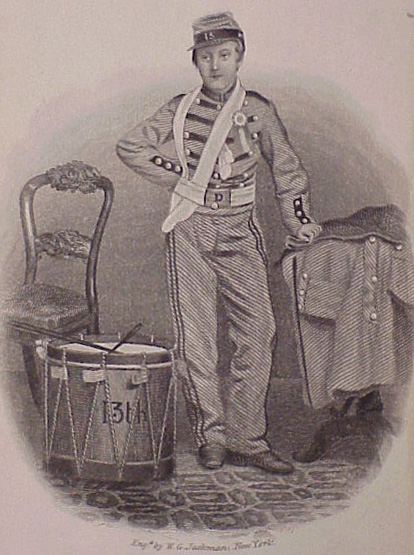
Clarence D. McKenzie: the Little Drummer Boy of the 14th Regiment, New York

As we have learned in previous posts regarding the role of drummer boys in the civil war, their duties comprised far more than tapping our rythyms; theirs was an important, and often dangerous job. Clarence D. McKenzie, the young drummer for the 13th Regiment, New York State Militia, paid the ultimate price when he was felled by an accidental discharge from a musket. McKenzie was 12 years old when he fell for the final time. His story is a reminder that war is very real and very lethal, regardless of how frequently and to what extent it is often romaticized.

In his tribute to young McKenzie, Luther Goodyear Bingham dscirbes the funeral procession as such:

The funeral of Clarence D. McKenzie, the little drummer boy, who was killed by the accidental discharge of a musket at Annapolis, Maryland, took place from St. John's Church, corner of Washington and Johnson streets, Brooklyn, at four o'clock in the afternoon of the fourteenth day of July. The body was removed under military escort from the house of the bereaved parents, No. 23 Liberty street, and placed in front of the pulpit. More... The children of Public School No. 8, and of the Sunday school connected with the Presbyterian church, corner of Tillary and Lawrence streets, to which deceased had been attached, were present and also occupied a large portion of the building. Many wore the emblem of mourning and showed sincere grief at .the loss of their friend and former school mate. The press was so great that thousands could not gain admittance.— The streets about the church were literally packed with spectators.

After the funeral services the face of the little drummer was exposed to view, and his former companions and class mates passed by and cast a last, sorrowful look upon it. This occupied perhaps half an hour, when the body was borne to the hearse by some of the soldiers of Company D, who brought it to this city. The coffin was enveloped in the American flag, and covered with wreaths of flowers and evergreen. The members of the Thirteenth Regiment now in this city, and the reserve corps, the whole under comman of Captain Balsdon, of Company D, formed the escort. Four drummers rolled the funeral march on the way to Greenwood Cemetery, where the body was interred. Three rounds of musketry were fired over the grave, and the solemnities were concluded.

The little brute companion of the drummer boy — his little faithful dog, followed the hearse to the grave, and when the coffin was lowered into it, he went forward and looked attentively down into the grave, to see where they had laid his young master. When the volleys where fired he ran away. When the procession moved away he remained, and when the grave was filled, laid himself down upon it. For many nights afterwards he was in the habit of going and spending a part of the night upon the grave, and toward morning he would return to the house where he belonged.

Thursday, September 24, 2009

Caring for the wounded at the Battle of Gettysburg: yankees aiding rebels

In several posts in this forum, we have discussed the everyday horrors of life in both Federal and Confederate prisons. As an alternative to this perspective, please allow us to consider the following excerpt from a volume entitled "Soldiers Letters From Camp, Battle-field and Prison." In this snippet, we hear Charles N. Maxwell, 3rd Maine, discusses the manner in which federal soldiers came to the aid of wounded and dying confederates on the Gettysburg battlefield. Maxwell writes:

On the morning of the 4th we took the front, and I was upon the skirmish-line watching the enemy's sharp-shooters, and exchanging shots with them. We were in the grass, and they several times climbed trees to see us, but we could take them out the first fire. That night, the cries of the wounded, during the storm which raged, was unpleasant in the extreme. I gave many of the rebel wounded water, and covered them up, for which they were grateful, and would urge me to take money. Our boys would mingle with them with the best of feelings — brave men after a desperate struggle respect each other.

Wednesday, September 23, 2009

The Battle of Gettysburg: the behavior of the townspeople through the eyes of a young girl

Part 5 in a series of posts regarding the behavior of the citizends of Gettysburg before, during, and after the great battle. In this entry we hear from Matilda J. "Tillie" Pierce Alleman who was 15 years old at the time of the historic event. In her book "At Gettysburg: or, what a girl saw and heard of the battle", young Tillie Pierce writes:

My native townsmen, during that terrible struggle, acted as patriotic and bravely as it was possible for citizens to act, who had suddenly thrust upon them the most gigantic battle of modern times.

They had none of the weapons or munitions of war; they were not drilled and were totally unprepared for such an unthoughtof experience, They were civilians.

Long before had many of their sons and brothers gone to the front, and those who still remained were as true to the Union as those found at home in the other towns of the North.

Upon the first rumor of the rebel invasion, Major Robert Bell, a citizen of the place, recruited a company of cavalry from the town and surrounding country.

More...

A company of infantry was also formed from the students and citizens of the place which was mustered into Col. Wm. Jennings' regiment of Pennsylvania Emergency Troops.

This regiment, on June 26th, was the first to encounter and exchange shots with the invaders of 1863. Though inexperienced, the stand they made, and the valor they displayed before an overwhelming force, cannot fail in placing the loyalty and bravery of her citizens in the foremost rank.

Opportunity was offered a few, who like old John Burns, went into the fray. To some like Professors Jacobs and Stower, came the occasion of explaining and pointing out to the Union officers the impregnable positions of the locality, and by this means insuring victory to our arms.

To others was given the oppottunity of concealing in their homes the brave Union boys who had been wounded in the first day's fight, who, in their retreat, had sought shelter in the house they could first reach, and there were Compelled to remain, within the Confederate lines, during the remainder of the battle.

Many a Union soldier would have gone to "Libby" or "Andersonville" had it not been for the loyalty and bravery of some of the citizens in thus secreting them.

To all was presented the opportunity of caring for the wounded and dying after the battle had passed, and nobly and feebly did they administer the tender and loving acts of charity even in their own homes as well as upon the field - and in the hospital.

Let those disposed to cavil and doubt the patriotism of the citizens of Gettysburg at the time of the battle forever cease, for what I have written is correct.

True it is there were a few who sympathized with the South just as in other Northern towns, but it would be unjust and unreasonable to condemn the many for the misdeeds of the few.

Friday, September 11, 2009

African American soldiers in the Civil War: the United States Colored Troops (USCT)

Pictured here is drummer boy Taylor of the 78th Regiment, United States Colored Infantry (USCI). While no full name is provided with the image of young Taylor, a quick examination of the National Park Service Civil War Soldiers and Sailors System reveals there were five soldiers named Taylor who served in the 78th regiment, USCI. These Taylors were as follows: Alfred, Joseph, Nelson, Robert, and Washington. Which of these five is pictured here with his drum? That question must go unanswered for now.... In the meantime, here's a summary of young Taylor's regimental history, courtesy of the National Park Service:

78th Regiment, United States Colored Infantry

Organized April 4, 1864, from 6th Corps de Afrique Infantry. Attached to 2nd Brigade, 2nd Division, Corps de Afrique, Dept. of the Gulf, to July, 1864. Post of Port Hudson, La., Dept. of the Gulf, to October, 1864. 2nd Brigade, 2nd Division, United States Colored Troops, Dept. of the Gulf, to October, 1864. Post of Port Hudson, La., Dept. of the Gulf, to April, 1865. District of LaFourche, Dept. of the Gulf, to January, 1866.

SERVICE.--Post and garrison duty at Port Hudson, La., till April, 1865, and at Donaldsonville, Thibodeaux and other points in District of LaFourche, Dept. of the Gulf, to January, 1866. Mustered out January 6, 1866.

Predecessor unit:

CORPS DE AFRIQUE.-UNITED STATES COLORED VOLUNTEERS.
6th REGIMENT INFANTRY.

Organized at Port Hudson, La., September 4, 1863. Attached to Ullman's Brigade, Corps de Afrique, Dept. of the Gulf, to December, 1863. 2nd Brigade, 2nd Division, Corps de Afrique, to March, 1864. Garrison, Port Hudson, La., to April, 1864.

SERVICE.--Duty at Port Hudson, La., August 31, 1863. Designation of Regiment changed to 78th United States Colored Troops April 4, 1864 (which see).

Saturday, September 5, 2009

Paul Revere at the Battle of Gettysburg: patriotism runs in the family

Did you know that Paul Revere, the famous "midnight rider" of Boston, had a grandson who was killed at the Battle of Gettysburg? Yes, it's true; Paul Joseph Revere was a Colonel in the 20th regiment Masachusetts Volunteers when he gave the last full measure on July 4, 1863. Below is an excerpt from the American Annual Cyclopaedia summarizing the accomplishments of Colonel Revere:

Revere, Col. Paul Joseph, an officer of U. S. volunteers, died of wounds received in the battle of Gettysburg. He was born in Boston, September 18th, 1832, and was a grandson of Paul Revere of Revolutionary history. His early educational advantages were good, and in 1862 he graduated at Harvard College. When the war broke out, though occupying a high sodul position and surrounded by everything calculated to make life pleasant, he at once volunteered his services on behalf of his country, and accepting the commission of major in the 20Uth regiment of volunteers, went to the seat of war. At the disastrous battle of Ball's Bluff his regiment behaved nobly, but lost heavily; he was taken prisoner and, with his colonel, was confined in a felon's cell as a hostage for the privateersmen whom the United States Court had convicted as pirates. After his exchange he participated in the campaign on the James river, and at Antietam was on General Sumner's staff, when he was complimented for his gallantry, having received a severe wound, which gave him a long winter of pain and seclusion. Upon his recovery he was promoted as colonel of the 20th regiment, and received his death wound in the first successful battle of the campaign.

Thursday, June 4, 2009

Coping in a Civil War prison: a Union officer describes his captivity in a Confederate prison

In earlier posts, we heard bits and pieces of the very bleak existence in the Civil War prisons. In this entry, George Haven Putnam, 1st Lieutenant in the 176th New York volunteers, describes the amnner in which he coped with life in the Danville Penitentiary.

On December 18th, 1864, Putnam writes:

Dear Mother,

I don't know how succesful my former letters have been in reaching you, but in spite of the chance of its being perhaps useless, I continue to write because the act itself seems to bring me nearer home, an is in itself a comfort. My circumstances have somewhat improved lately. I have borrowed some little money from an officer lately arrived., whom I had formerly known, and am able therewith to purchase some small additions to my rations which are very acceptable. I have had for a chum since my capture a young fellow named VenderWeyde, with whom I get along very well. He contributed to the partnership a blanket, cup, plate, and knife, I a plate, fork, spoon, cup, blanket and canteen; for the last two months we have marched, hungered, feasted, slept, and lived in common. Two blankets make a better bed than one, and the majority of our officers have formed such partnerships. It would be interesting to you to be able to look into our "apartment," and observe the various ways in which our men manifest themselves in captivity. Many are engaged in the laborious task of splitting wood with table knives and wooden wedges, some are playing chess, cards, or checkers; some unfortunate ones who have obtained books are reading or studying; a few like myself are engaged in the pleasing occupation of writing home, while some unfortunates on whom imprisonment has acted hardly, are sitting gazing vacantly, stupidly, desolately into nothingness -- waiting for brighter days. The floor serves as seats, bedstead, and table for us all. We are hoping that boxes from home will reach us by New Year's. I have sent several lists of wants. Money is the principal one. Reciprocations are sometimes effected with the friends of Southern prisoners North.

Yours trustfully

Haven

Monday, June 1, 2009

A civil war drummer boy cares for the wounded: "I never want to go into a hospital again"

In a previous post, we heard David Auld, drummer boy for the 43rd Ohio volunteers, discuss the horrors of battle and the role the drummer boys played in caring for the wounded, dead, and dying. Here, Charles William Bardeen, drummer boy for the 1st Massachusetts Volunteers, company D, discusses his experiences during the Battle of Fredericksburg.

Bardeen writes:

Dear Mother,

When I closed my last it was Sunday Morning. I will relate what has passed since then. I believe I mentioned that there were several wounded Rebels brought in. As they were suffering badly, I made a Coffee pot full of coffee, giving it to all of them who wished. Most of them were in Georgia Regts, particularly the 61st & 62d & 60th One was the Adjutant Gen'l of Erwin's Brigade, under Jackson, and in the absence of Erwin he led the Brigade in a charge upon one of our batteries. Our infantry in front united to give the batteries a chance to open with cannister, which, as soon as the enemy were near enough, they did, with terrible effect. Our infantry then advanced and took many prisoners. This Adj-Gen'l was wounded in the Groin and was in great pain. In company with all of them, he expressed great surprise at the kind treatment he received at our hands. He said he was treated as well as our own boys. All day I staid there, doing all I could for all of them. At night we went out a little way from the Hospital to sleep. I saw many legs & arms taken off, and the sight was awful. The men say that it is not battle but butchery, as the rebels are well protected by breastworks. Monday morning we were ordered back across the river, as the Div. Hospital had been established there. So the drummers were put in reliefs of six hours each to attend to the wounded. My relief is on at dark. The following were the instructions given to me by the Nurse, in the tent assigned to me. "The men on the left side will not require much attention. That man in the corner is wounded through the temple and is insane. You will have to hold him down if he attempts to get up, and you must keep close to him and keep him covered. The one next to him is crazy also. Every time he wakes up you must give him some water & look out that he does not get up. The one in this corner has got the Dysentery and will require the Bedpan often—You must pay strict attention to them all, and not let the crazy men get the upper hands of you." So off he went and left me alone with two crazy men and 6 or eight wounded ones to attend to. It was a hard place, but I did my duty as well as I was able 'till my six hours were up. I never want to go into a Hospital again.

Sunday, March 1, 2009

A brave drummer boy earns the Congressional Medal of Honor

In his New Jersey and the Rebellion, John Y. Foster describes the heroism of a young drummer boy name William Magee. For his valiant efforts, Magee was awarded the Congressional Medal of Honor. Magee's citation reads, "In a charge, was among the first to reach a battery of the enemy and, with one or two others, mounted the artillery horses and took two guns into the Union lines."

Foster describes the details of drummer boy Magee's bravery in his account. He writes:

Among the many instances of youthful intrepidity and daring, none, perhaps, exceeded in all the points of real sublimity those which are furnished in the career of drummer William Magee, of the Thirty-third Regiment. This lad, for he was only a lad, entered the service at fifteen years of age-leaving a widowed mother in the city of Newark-to aid in maintaining the unity of the Nation. From the first he displayed qualities of the highest order. Intelligent, fearless, vigilant, he was at all times an example alike to superiors and inferiors. Though entering the service as a drummer, he by no means confined himself to the duties of his specific sphere. He had a knack of fighting as well as drumming, and withal exhibited an appreciation of the methods of warfare which qualified him for the most surprising exploits. One of these, at least, was equal in splendor of execution and grandeur of result to any which the history of the war records. It will be remembered that in the fall of 1864, after Sherman had swung loose from his base and started on his stately' March to the Sea," Hood with an army of forty thousand men laid siege to Nashville, defended by General Thomas. Here, for a period of two or three weeks, our troops were penned up with little prospect of relief.

More...

At Murfreesboro, thirty miles away, General Thomas, reluctant to relax his hold on the railroad to Chattanooga, had stationed a small garrison under General Milroy. This garrison, as the rebels gathered in greater force, beleaguering the post, soon became comparatively isolated, all avenues of escape being practically closed. But the men did not lose heart. At length, on the 2d of December, it was determined to strike a blow for deliverance. At this time, young Magee had become acting orderly to General VanCleve, and to him, youth as he was, the order was given to charge the enemy. It may be that a smile accompanied the order-a smile at the thought of committing such a work to a mere stripling; but it is certain that the confidence of the'commander was not misplaced. Taking the One Hundred and Eighty-first Ohio Infantry, Magee sallied out of the works, and rushed upon a battery posted on an eminence hard by. The charge was made most gallantly, but the fire of the enemy was resistless, and slowly the column fell back. But the intrepid orderly did not for a moment falter in his purpose. One repulse only stimulated his appetite for his work, and accordingly, selecting the One Hundred and Seventyfourth Ohio, he again moved out, again charged the foe, again met their withering fire; still, however, pressing on until at last the victory was his. And it was no ordinary victory. Two heavy guns and eight hundred of the enemy killed, wounded and captured, were the trophies which he brought out of the contest. Nor was this all. This signal success at once dispiriting the enemy and reviving the hopes of our own men, proved the first of a series of victories which resulted, finally, in driving Hood from Tennessee and restoring that whole section to Federal control. The readiness and gallantry displayed by young Magee in this affair very naturally attracted the attention of those around him, and he received the hearty commendation of Generals Rosseau, Milroy, and other officers in command. Subsequently he received a medal of honor from the War Department, inscribed, " The Congress to drummer William Magee, Company C, Thirty-third Regiment, New Jersey Volunteers."

Tuesday, February 17, 2009

Civil War correspondent C.C. Coffin on the horrors of war

The American Civil War, like many wars, has been romanticized endlessly in books and on film. For those observers who view from such safe and secure distances, the everyday toils and the absolute horrors of battle and death may become somewhat sanitized. Charles Carleton Coffin, Civil War correspondent to the Boston Journal witnessed firsthand the gruesome nature of war and the very real impact it has on young lives. Of this horror, Coffin writes:

But let me say if those who envy the war correspondent were once brought into close contact with all the realities of war — if they were obliged to stand the chances of getting their heads Knocked off by an unexpected shell, or bored through with a minie ball, — to stand their chances of being captured by the enemy, — to live on bread and water and little of it — to sleep on the ground, or on a sack of corn, or in a barn with the wind blowing a gale and the snow whirling in drifts, and the thermometer shrunk to zero,— and then after the battle is over and the field won, to walk among the dying and the dead and behold all the ghastly sights ... to hear all around sighs, groans, imprecations and prayers — they would be content to let others become the historians of war.

Courage of the color bearer

In other posts, we've dscussed the dangers related to carrying the regimental colors into battle. It took special person to fill the color bearer's shoes.

In his Reminiscneces of the Civil War, General John Brown Gordon describes in vivid detail a color bearer's courage and determination despite horrific injuries. Brown writes:

At Big Falls, North Carolina, there lived in 1897 a one-armed soldier whose heroism will be cited by orators and poets as long as heroism is cherished by men. He was a color-bearer of his regiment, the Thirteenth North Carolina. In a charge during the first day's battle at Gettysburg, his right arm, with which he bore the colors, was shivered and almost torn from its socket. Without halting or hesitating, he seized the falling flag in his left hand, and, with his blood spouting from the severed arteries and his right arm dangling in shreds at his side, he still rushed to the front, shouting to his comrades: " Forward, forward!" The name of that modest and gallant soldier is "W. F. Faucette.

Saturday, February 14, 2009

In defense of John Burns, citizen soldier of Gettysburg

The story of John Burns, "citizen soldier" of the Battle of Gettysburg, is such a compelling one that it was even the subject of a poem by Bret Harte. The Pennsylvania Board of Commissioners on Gettysburg Monuments was so impressed with Burns's heroics that they saw fit to commission a monument of him on the Gettysburg battlefield (pictured here). Over the years some have come to doubt the actual role Burns played in the battle. Was the story of the old volunteer fact or fiction? Here, in A Califonia Tramp, and Later Footprints, author Thaddeus Stevens Kenerdine believes the latter as he quotes Sergeant George Eustis of the 2nd Wisconsin. Eustis states:

"If any of those who think that the old man took no part in the battle of Gettysburg had seen him on the 1st of July, 1863, they would change their opinion. I can't tell just what time he came up to us, having left my watch at home on the bureau that morning, but it was after we had captured Archer's Brigade, and while we were lying down in the timber to protect ourselves from the shot and shell flying around, about noon, say, that I saw a little old man coming up in the rear of our company, F. I remember him well. He had on a swallow-tail coat, with smooth brass buttons. We boys commenced to poke fun at him, thinking him a fool to come up where there was so much danger. I wanted to put a cartridge box on him to make him look like a soldier, telling him he couldn't fight without that. His reply was, slapping his pockets, ' I can get my hands in here quicker than in the box; I am not used to them new-fangled things.' More... In answer to a question as to what made him come up there, he said the rebels had either milked his cows or driven them away, and he was going to be even with them. All this while the shells were screaming and bursting over the protecting timber. About this time the " rebs " began to advance. Bullets were whistling around pretty lively. We hugged the ground closer and the old man got behind a tree. He surprised us all by not taking a double- quick to the rear, but he was just as cool as any veteran among us. We soon had orders to move a hundred yards to the right, and were shortly engaged in one of the hottest fights I was ever in. Foot by foot we were driven back. We made our last stand at the Seminary, where we did good work for a while and then retreated through the town to Cemetery Ridge. I never saw John Burns after we moved to the right. From some cause he did not follow, and we left him with his gun behind the tree. I learned afterward he was wounded in three places. General Callis was wounded and left for dead on the field."

Sunday, December 21, 2008

George D. Sidman: the heroics of a Civil War drummer boy

In June of 1862 George D. Sidman was a 16 year old drummer boy with the 16th Michigan Infantry, Company C. In the midst of an assault at Gaines Mills, Virginia, Sidman volunteered to carry the regimental flag and rallied his comrades in the face of grave danger until he was wounded in the hip. For his distinguished bravery, Sidman was awarded the Medal of Honor.

In recounting sidman's heroics on that day, Captain Ziba Graham stated:

"Well do I remember that December day in 1862, as we stood en masse on Stafford Heights, overlooking Fredericksburg, all ready to cross the Rappahannock, when the first brigade colors for our brigade were brought upon the field. I can see now the eagerness with which this comrade Sidman, a mere boy, with scarce the down of young manhood upon his chin, sprang forward from the ranks and begged of me the permission to carry those colors. It was granted. Colonel Stockton in command, admiring his pluck but deprecating his youth, finally gave his consent. Sidman brought them out of that hell of fire, many holes shot in them, himself wounded. On his breast to-day he wears the medal of honor, a patent of nobility for bravery far above riches and above price."

Sunday, December 14, 2008

The Battle of Gettysburg: A surgeon speaks of the hospitality of the citizens of Gettysburg

Part 4 in a series of posts regarding the behavior of the citizens of Gettysburg before, during, and after the great battle. In this post, we hear from Captain Louis C. Duncan, Medical Corps, U.S. Army. In the September, 1913 issue of "The Military Surgeon", Duncan writes:

"Allow me here to remark that the stories published, charging the people of the town with a want of hospitality toward the soldiers, are basely false. In those days of suffering I gathered bread from house to house, and the last loaf and half loaf was always cheerfully given."

"During the battle of the first day, when shells were shrieking and bursting around the hospitals, even the women were found in the midst of the wounded men as they were carried in from the field; and from that time on all through the terrible days, and afterwards down to the close, in every hospital, at all times, with a devotion that never flagged, or counted any sacrifice too great, our noble women were found, like angels of mercy, binding up wounds and administering food. Ask the many hundreds of wounded men, who filled the warehouses, halls, churches, and so many of the private dwellings, what they think of the hospitality of the people of Gettysburg."

"The Rebels, though disposed to help themselves, were generally civil, and even respectful toward the citizens."

Saturday, December 6, 2008

Battle of Petersburg: an officer speaks of the dead

Theodore Lyman served on the staff of Major General Meade as aide-de-camp with a commission as lieutenant-colonel from Governor Andrew of Massachusetts. Lyman followed Meade until the end of the war from September 2, 1863, to April 20, 1865. During this time, he served as headquarters archivist. He also put his life on the line carrying flags of truce through hostile lines at Cold Harbor and Petersburg. His published letters and notebooks establish him as the preeminent recorder of events and personalities within the headquarters of Army of the Potomac.

Lyman was present at the Battle of Petersburg in June, 1864, wherein the Union forces suffered terrible losses. Lyman's June 25, 1864 diary entry speaks of these losses. In this entry, he writes:

"I recollect sitting on the high bank of the Rapid Ann [sic], at Germanna Ford, and watching the 5th and 6th Corps as they marched up from the pontoon bridges; and I remember thinking how strange it would be if each man who was destined to fall in the campaign had some large badge on! There would have been Generals Sedgwick, Wadsworth, and Rice, and what crowds of subordinate officers and of privates, all marching gaily along, unconscious, happily, of their fate.

Tuesday, December 2, 2008

Battle of Gettysburg: John Burns strikes again?

In an earlier post we discussed John Burns, the "citizen soldier" who at the Battle of Gettysburg picked up his musket in defense of his hearth and home. Now, hidden amongst the pages of A.P. Smith's History of the Seventy-sixth Regiment New York Volunteers we find this reference:

"As the regiments were pushing forward, before the fighting commenced, a gray-haired man, sixty years of age, rushed across the fields, gun in hand, and attempted to reach the front; but being unable to overtake the Seventy-sixth New York, he fell in with the Fifty-sixth Pennsylvania, and fought with that Regiment all day. Had all the residents of Gettysburg been equally patriotic and courageous, the result of the first day's fighting might have been more disheartening to the South, and rendered the terrible fighting of the next two days unnecessary."